Ring - the regulatory intelligence engine that simplifies your life
The pharma industry drowns in regulatory documentation. Ring (A3P + Aktehom + Mindexia) lets you query 1,700+ life science referentials in plain language. Concrete use cases in cleaning validation.
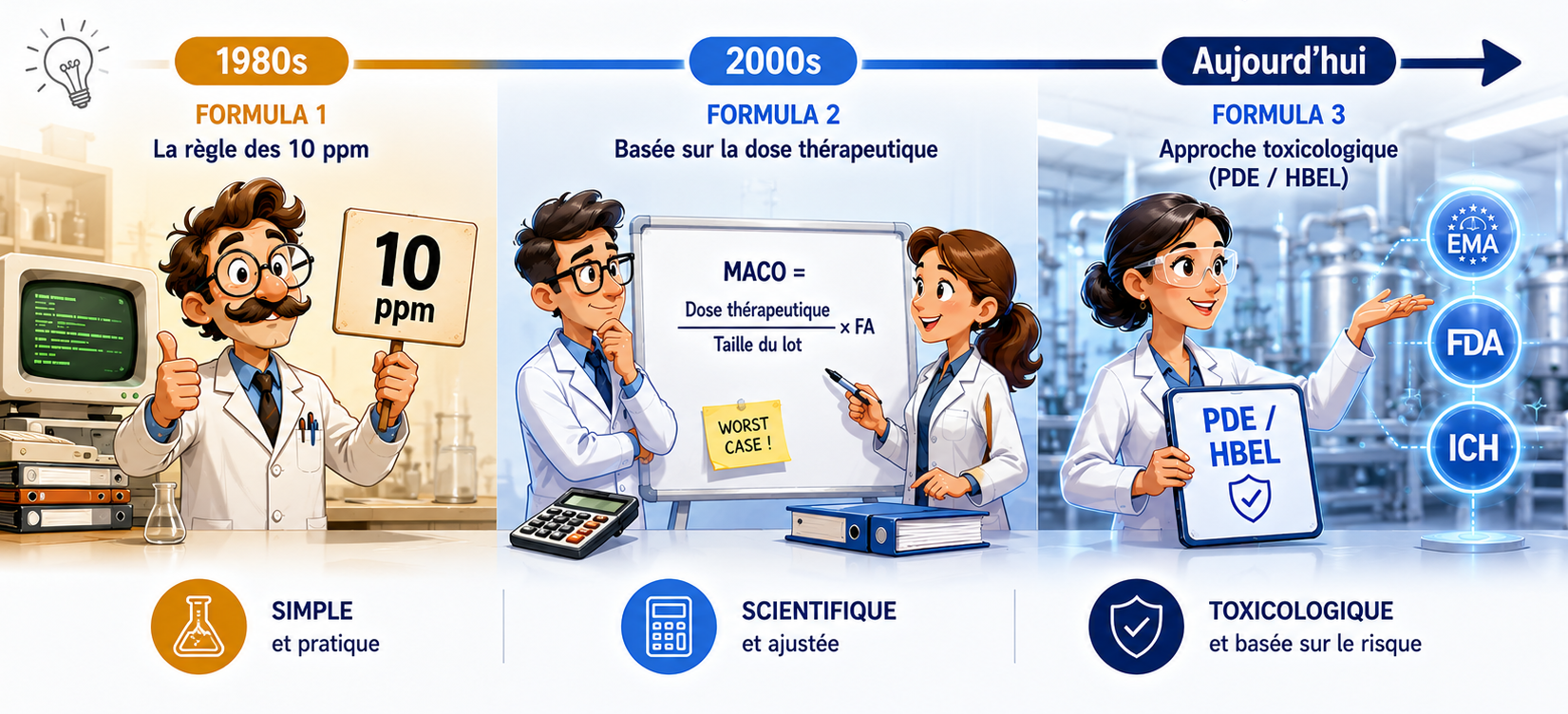
How to Calculate MACO in Cleaning Validation: The 3 Formulas, Their History and Regulatory Sources
MACO by therapeutic dose, HBEL/PDE or 10 ppm rule: the 3 formulas detailed with regulatory history, worked examples, and why the LD50 approach is prohibited.
Strengths and limits of the matrix approach
The matrix approach groups similar entities rather than validating
each product-equipment combination. Promising, it can also become
a source of risk if poorly constructed.
Another approach for toxicity scoring in the definition
of worst-case products
When HBEL values are not available, Occupational
Exposure Bands (OEB) offer a quick and consistent alternative
for scoring toxicity.
The great debate: swabbing or rinsing?
Direct sampling by swab or indirect by rinsing? The
two methods work on different principles and provide
distinct information. Full comparison.
How to optimize acceptance criteria in cleaning validation?
Calculating acceptance thresholds is not that complicated, but
several parameters can be adjusted to bring them closer
to production reality.
Cleaning validation: auditors' expectations and pitfalls to avoid
20 to 30% of deviations noted during GMP inspections concern cleaning
validation. What auditors expect and how
to avoid classic pitfalls.
Cleaning validation: glossary of key terms (MACO, ARL, LOD,
LOQ…)
MACO, ARL, PDE, LOD/LOQ, recovery rate… Each term has important
implications for patient safety, regulatory compliance
and risk management.
How to tackle the challenge of acceptance criteria in a
multi-product environment
In a multi-product environment, the number of product A
in B combinations can explode. Here is how to approach this challenge without
losing the regulatory thread.
Cleaning validation: the documents you need to know
Annex 15, FDA 21 CFR Part 211, PDA TR 29 & 49… Do you really know
all the documents that govern the validation of
cleaning processes?
The worst-case product trap
The worst-case approach rests on a simple principle: if it works for
the hardest, it works for the rest. But in practice, choosing the worst-case
product is fraught with pitfalls not to be underestimated.