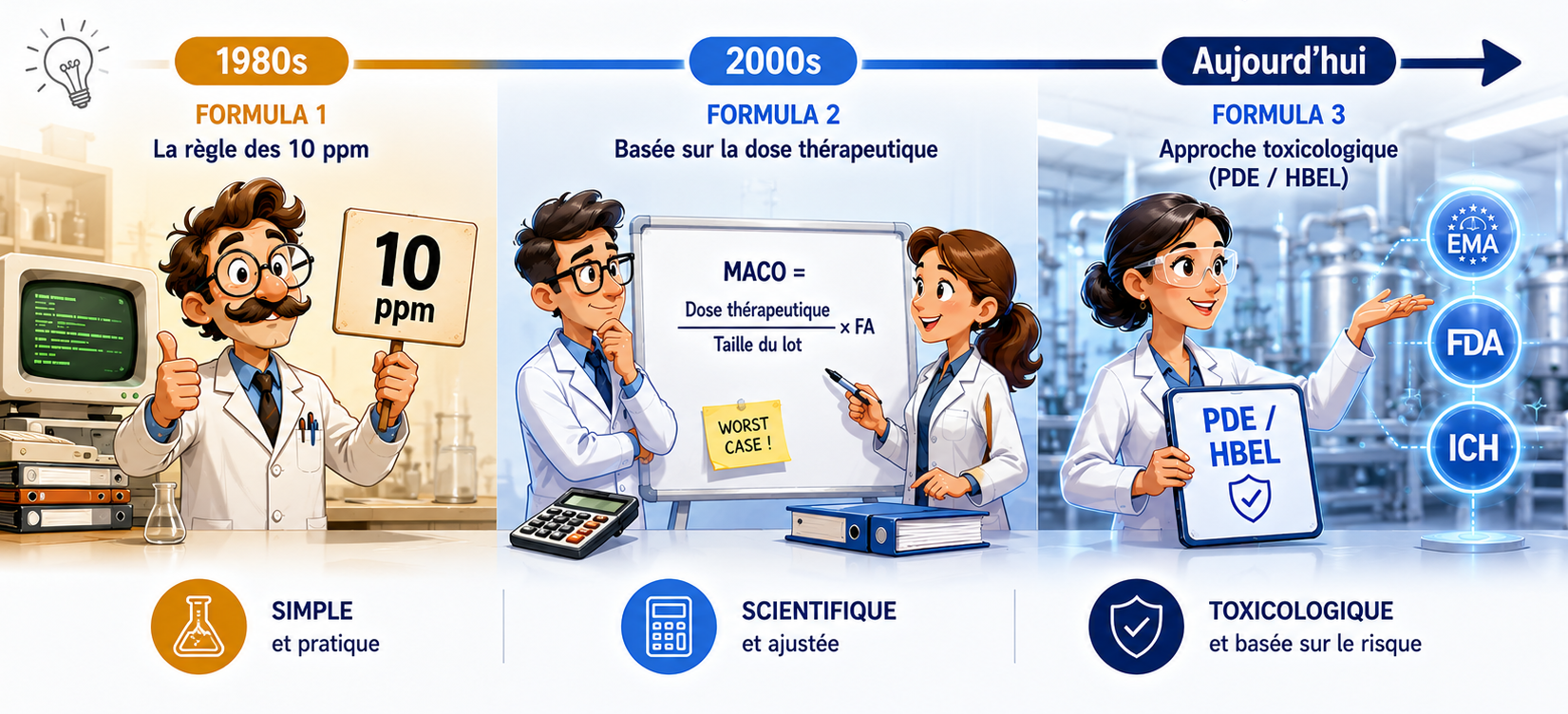
Cleaning validation rests on a fundamental question: how much residue from the previous product can be tolerated in the next finished product?
The concept seems simple. But on what scientific basis should this threshold be set? The answer has evolved significantly over thirty years, going through three generations of calculation methods — and some practices still in use today have become non-compliant.
What is MACO? Definition and common parameters
Definition
The MACO (Maximum Allowable Carryover) is the maximum quantity of active substance residue from product A — the product previously manufactured on a piece of equipment — that may be transferred into a batch of product B, without risk to the health of the patient receiving product B.
In practice: if your site successively manufactures parexcelatol and then flexovexol on the same production line, the MACO tells you how many milligrams of parexcelatol residue are acceptable in the flexovexol batch. This calculation is performed for each product A → product B pair in your portfolio.
MACO ≠ acceptance criterion. The MACO is an absolute quantity (in mg for example). The acceptance criterion (ARL for Acceptance Residue Limit) on surface (µg/cm²) is derived from it in a second step, by dividing the MACO by the shared surface area.
Parameters common to all three formulas
Regardless of the formula used, two parameters of product B always enter the calculation:
| Parameter | Symbol | Definition | Why this choice? |
|---|---|---|---|
| Smallest Batch Size of product B | SBS(B) | Smallest batch size of product B (mg) | Conservative: a smaller batch concentrates the residue more per dose unit |
| Largest Daily Dose of product B | LDD(B) | Largest daily dose administered of product B (mg/day) | Conservative: the patient at maximum dose is most exposed to the residue |
These two parameters represent the patient-side worst case: the smallest batch and the highest dose. This ensures that the MACO protects even the patients most at risk of exposure.
Formula 1 — The empirical 10 ppm rule
Context and birth of the rule
In the 1990s, the pharmaceutical industry did not yet have a harmonised regulatory framework for cleaning validation. FDA inspectors had to assess equipment cleanliness without a shared calculation framework.
It was in this context that the FDA Guide to Inspections of Pharmaceutical Quality Control Laboratories (1993) introduced a pragmatic concept: limiting residues to 10 ppm (parts per million) in the next product. The underlying idea is simple — if a residue does not represent more than one ten-millionth of the product subsequently manufactured, it is considered acceptable from a dilution standpoint.
This rule was then taken up and formalised in the PIC/S PI 006 guide (Recommendation on Cleaning Validation), which remains one of the main reference texts for cleaning validation in PIC/S member countries.
Regulatory sources
- FDA — Guide to Inspections of Pharmaceutical Quality Control Laboratories (1993)
- PIC/S — PI 006-3 Recommendation on Cleaning Validation (successive editions)
The formula
- SBS(B) = Smallest Batch Size of product B (mg) — smallest batch size of the next product
This formula can also be expressed in mass units: residue from A must not exceed 10 mg per kg of product B manufactured.
Worked example
Let product B have SBS(B) = 100 kg = 100,000,000 mg.
The 10 ppm rule allows 1 gram of product A residue in a 100 kg batch of product B.
When to use this formula?
- As a complementary verification criterion — never as the sole criterion
- Applicable without clinical or toxicological data
- Useful for detecting inconsistencies in calculations from other formulas
Limitations and current status
The 10 ppm rule is fundamentally arbitrary: 10 mg/kg of a highly allergenic beta-lactam antibiotic does not carry the same clinical significance as 10 mg/kg of a standard excipient. For a highly active drug (hormone, anticancer, immunosuppressant), this limit may be tens of thousands of times too permissive.
The 10 ppm rule can no longer be used as the sole criterion since the EMA guideline of 2014 and the revision of EU GMP Annex 15 (2015). It remains acceptable as a complementary verification criterion, but cannot alone form the basis of acceptance criteria for a cleaning validation study.
Formula 2 — The therapeutic dose approach (mTD/SF)
History and regulatory formalisation
At the end of the 1990s, the pharmaceutical industry sought to move beyond the arbitrariness of 10 ppm. A more rational approach emerged: rather than limiting the residue to an arbitrary fraction of the next product, it is related to the minimum therapeutic dose of the residual substance itself.
The principle: if the quantity of A residue ingested by a patient in their dose of B is less than 1/100 of the minimum active dose of A, this residue has no significant pharmacological effect.
This approach is formalised in PIC/S PI 006-3 and in the ISPE Baseline Guide Vol. 7 Risk-MaPP (Risk-Based Manufacture of Pharmaceutical Products). It was the dominant approach in the pharmaceutical industry from the 2000s until the publication of the EMA guideline in 2014.
Regulatory sources
- PIC/S — PI 006-3 Recommendation on Cleaning Validation
- ISPE — Baseline Guide Vol. 7: Risk-MaPP
- EU GMP Annex 15 (2015 revision)
- ICH Q7 — Good Manufacturing Practice Guide for Active Pharmaceutical Ingredients
The formula
- mTD(A) = minimum Therapeutic Dose of product A — smallest clinically active dose (mg/day)
- SBS(B) = Smallest Batch Size of product B (mg)
- LDD(B) = Largest Daily Dose of product B — largest prescribed daily dose (mg/day)
- SF(A) = Safety Factor of product A — safety factor based on the route of administration of product A (dimensionless)
The safety factor SF(A)
Its default value is 1/100 (i.e. 0.01), as cited in PIC/S PI 006. The ISPE Risk-MaPP guide specifies that SF(A) may vary according to the route of administration of product A:
| Route of administration of product A | Recommended SF(A) (ISPE Risk-MaPP) |
|---|---|
| Topical | 1/10 |
| Oral | 1/100 |
| Parenteral | 1/1,000 |
| Ophthalmic | 1/1,000 |
| Investigational product | 1/10,000 |
These values are starting points. The justification for the SF used must always be documented in the validation file.
Worked example
Scenario: Product A = parexcelatol, product B = flexovexol, oral routes.
- mTD(A) = 500 mg/day (minimum therapeutic dose of parexcelatol)
- SBS(B) = 100 kg = 100,000,000 mg
- LDD(B) = 2,400 mg/day (maximum daily dose of flexovexol)
- SF(A) = 1/100 (oral route of product A)
The mTD/SF approach allows approximately 208.3 grams of parexcelatol residue in a 100 kg batch of flexovexol.
Advantages and limitations
Advantages:
- Based on real and accessible clinical data (mTD published in monographs)
- More protective than 10 ppm for substances with high pharmacological activity
- Widely accepted by regulatory authorities as a valid complementary criterion
Limitations:
- The mTD is not always available or clearly documented
- Does not capture chronic toxicity, genotoxicity or carcinogenicity
- Insufficient alone for highly active API products (hormones, cytotoxics, biologics)
- Must be systematically supplemented by the HBEL/PDE approach
Formula 3 — The HBEL/PDE approach (Health-Based Exposure Limit)
History and emergence of the concept
The PDE (Permitted Daily Exposure) concept originated in pharmaceutical chemistry with the guideline ICH Q3C (1997), initially designed to set acceptable limits for residual solvents. The central idea is powerful: establish a daily exposure limit based on the complete toxicological profile of a substance, applying scientifically justified adjustment factors.
During the 2000s and 2010s, several organisations — notably ISPE with the ADE (Acceptable Daily Exposure) concept — transposed this approach to cleaning validation.
The regulatory breakthrough came in November 2014 with the publication by the EMA of the Guideline on setting health based exposure limits for use in risk identification in the manufacture of different medicinal products in shared facilities (EMA/CHMP/CVMP/SWP/463311/2013). The revision of EU GMP Annex 15 (2015) confirmed this in GMP positive law.
Regulatory sources
- EMA/CHMP/CVMP/SWP/463311/2013 — Guideline on setting health based exposure limits (November 2014) — founding text
- EU GMP Annex 15 (2015 revision) — section 10
- ICH Q3C — Impurities: Guideline for Residual Solvents (1997) — origin of the PDE concept
- ISPE — Baseline Guide Risk-MaPP — ADE concept
- EMA — Questions & Answers on implementation of risk-based prevention of cross-contamination in production (2018)
PDE or ADE: two names, one concept
PDE (Permitted Daily Exposure) is the EMA/ICH Q3C terminology. ADE (Acceptable Daily Exposure) is the ISPE/IPEC terminology. Both refer to the same concept and are interchangeable if calculated using the same methodology. In a European dossier, prefer PDE.
How is the PDE calculated?
The PDE is established by a qualified toxicologist based on the complete toxicological profile of the substance. Its generic formula is:
- NOAEL = No-Observable-Adverse-Effect Level — dose with no observable adverse effect
- F1 = inter-species extrapolation factor (2 to 12 depending on species)
- F2 = intra-species human variability (generally 10)
- F3 = duration of studies (1 for chronic studies, up to 10 for short studies)
- F4 = severe irreversible toxicity (1 to 10)
- F5 = absence of NOAEL, use of LOAEL (1 to 10)
Important: the PDE calculation is not performed by the validation team. It is established by a certified toxicologist based on an exhaustive review of available preclinical and clinical data. This document is referenced in the validation file as the scientific justification for the HBEL limit.
The MACO HBEL/PDE formula
- PDE(A) = Permitted Daily Exposure of product A (mg/day) — established by toxicologist
- SBS(B) = Smallest Batch Size of product B (mg)
- LDD(B) = Largest Daily Dose of product B (mg/day)
The safety factor SF does not appear explicitly in this formula: it is already integrated into the PDE calculation through factors F1 to F5.
Worked example
Scenario: Product A with PDE(A) = 1.5 mg/day. Product B: SBS(B) = 100 kg = 100,000,000 mg, LDD(B) = 2,400 mg/day.
The HBEL/PDE approach is today the mandatory reference approach for any shared facility, in accordance with EU GMP Annex 15 (2015) and the EMA guideline (2014). The mTD/SF and 10 ppm approaches remain valid as complementary criteria, but the HBEL must be calculated for all products concerned.
The LD50 approach: a non-compliant practice to abandon
Warning: the use of LD50 as a basis for MACO calculation is explicitly rejected by the EMA guideline (2014). A cleaning validation dossier based on this approach will be considered non-compliant during an EMA, ANSM or FDA inspection.
What the LD50 approach was
Before the formalisation of clinical and toxicological approaches, some laboratories calculated the MACO based on the LD50 (Lethal Dose 50%: dose killing 50% of exposed laboratory animals).
The apparent logic: if substance A has low toxicity (high LD50), a larger residue can be tolerated. The approximate formula used was of the type:
MACO ≈ LD50 × patient weight × conversion factor / LDD(B)
Why this approach is prohibited
LD50 is a measure of acute lethal toxicity obtained from short-term animal studies. It does not reflect:
- Chronic toxicity (long-term effects of repeated exposure)
- Genotoxicity and carcinogenicity
- Reproductive and developmental toxicity
- Effects on vulnerable populations (children, pregnant women, immunocompromised)
- Sensitisation and allergic reactions (e.g. beta-lactams)
The EMA 2014 guideline is explicit: safety limits must be established from a complete toxicological assessment, performed by a qualified toxicologist, integrating all available data on the substance. LD50 alone is not an acceptable basis.
What to do if you still use the LD50 approach?
- Identify all studies and acceptance criteria based on LD50 in your portfolio
- Have established a PDE/ADE by a qualified toxicologist for each substance concerned
- Recalculate all MACO and acceptance criteria based on the PDE
- Update the impacted protocols, reports and batch files
- Document the transition and its justification in your quality system
Comparative table of the three formulas
The three approaches complement each other. Here is a comparative summary:
| Criterion | 10 ppm | Therapeutic dose (mTD/SF) | HBEL/PDE |
|---|---|---|---|
| Formula | 10 × 10⁻⁶ × SBS(B) | mTD(A) × SBS(B) / (LDD(B) × SF(A)) | PDE(A) × SBS(B) / LDD(B) |
| Main source | FDA 1993, PIC/S PI 006 | PIC/S PI 006, ISPE Risk-MaPP | EMA 2014, EU GMP Annex 15 |
| Key data required | Batch size only | mTD of product A | PDE established by toxicologist |
| Accounts for toxicity | No | Partially (active dose) | Yes — complete profile |
| Suitable for highly active APIs | No — too permissive | Insufficient alone | Yes — mandatory |
| Regulatory status 2025 | Complementary criterion | Valid complementary criterion | Mandatory (shared facilities) |
Which formula to choose — and in what order?
New facility vs. legacy line: two situations, two logics
The answer depends on the context of your cleaning validation programme:
| Context | Recommended approach |
|---|---|
| New facility or new product | The HBEL/PDE approach is mandatory and can be used alone as the reference criterion, in accordance with EU GMP Annex 15 (2015). mTD/SF and 10 ppm may complement but are not required. |
| Legacy production line with existing validation | Calculate all three formulas and retain the lowest MACO as the reference value. This conservative approach covers existing studies and limits regulatory risk during an inspection. |
Additional rules
- The calculated MACO applies for the A → B direction. Calculate B → A separately if the sequence can be reversed.
- Review MACO values upon any change in formulation, batch size, or therapeutic or toxicological data.
Comparative worked examples: same scenario, three formulas
Two contrasting scenarios show how the three formulas can diverge significantly depending on the profile of product A.
Scenario 1 — Standard product A (parexcelatol)
Parameters:
- Product A (parexcelatol): mTD(A) = 500 mg/day, PDE(A) = 1.5 mg/day, oral route, SF(A) = 1/100
- Product B (flexovexol): LDD(B) = 2,400 mg/day, SBS(B) = 100 kg = 100,000,000 mg
| Formula | Calculation | MACO |
|---|---|---|
| 10 ppm | 10⁻⁵ × 100,000,000 mg | 1,000 mg |
| mTD/SF | (500 × 100,000,000) / (2,400 × 100) | 208,333 mg |
| HBEL/PDE | (1.5 × 100,000,000) / 2,400 | 62,500 mg |
Result: The 10 ppm rule is the most restrictive (1,000 mg). For parexcelatol — a substance with a high therapeutic dose and high PDE — the 10 ppm limit can paradoxically be the limiting criterion.
Scenario 2 — Product A: highly active API (hormone)
Parameters:
- Product A (hormone, highly active API): mTD(A) = 0.002 mg/day, PDE(A) = 0.001 mg/day, oral route, SF(A) = 1/100
- Product B (flexovexol): LDD(B) = 2,400 mg/day, SBS(B) = 100 kg = 100,000,000 mg
| Formula | Calculation | MACO |
|---|---|---|
| 10 ppm | 10⁻⁵ × 100,000,000 mg | 1,000 mg |
| mTD/SF | (0.002 × 100,000,000) / (2,400 × 100) | 0.833 mg |
| HBEL/PDE | (0.001 × 100,000,000) / 2,400 | 41.7 mg |
Result: The mTD/SF approach is by far the most restrictive (0.833 mg). The 10 ppm rule (1,000 mg) would be 1,200× too permissive — an aberration for a highly active API.
These two scenarios demonstrate why stepping back to assess which calculation formulas to apply is essential: there is no universally most conservative formula. The most restrictive value depends on the specific profile of each product A / product B pair. There is no universal method that always works and that would consist of always applying all 3 calculation approaches regardless.
Frequently asked questions
Which MACO formula is mandatory in 2025?
The HBEL/PDE approach is mandatory for any shared facility since the revision of EU GMP Annex 15 (2015) and the EMA guideline (2014). However, authorities sometimes expect all three formulas to be calculated and the most restrictive criterion to be retained. The mTD/SF and 10 ppm approaches are valid as complementary criteria but do not replace HBEL/PDE.
Can the 10 ppm rule still be used?
Yes, but only as a complementary verification criterion. Used alone, the 10 ppm rule is no longer acceptable as the sole basis for calculating acceptance criteria since 2015. It remains useful for detecting inconsistencies or as an additional safety net.
What is the difference between PDE and ADE?
PDE (Permitted Daily Exposure) and ADE (Acceptable Daily Exposure) refer to the same concept. PDE is the EMA/ICH Q3C terminology; ADE is the ISPE terminology. Both are interchangeable if calculated using the same toxicological methodology. In a dossier submitted to a European authority, prefer the term PDE.
Who can calculate a PDE/ADE?
The PDE must be established by a qualified toxicologist with training in regulatory toxicology and experience in pharmaceutical risk assessment. This is not a calculation that the validation team performs independently. Specialist service providers offer this service for substances without a published PDE.
MACO and acceptance criterion (ARL): what is the difference?
The MACO is an absolute quantity of residue (in mg). The acceptance criterion is the measurable field value: in µg/cm² for swabbing, or in µg/mL for rinse analysis. The MACO is converted to the ARL by dividing by the shared surface area.
Should MACO be calculated in both directions?
Yes, if the manufacturing sequence can be reversed. MACO(A→B) and MACO(B→A) are calculated separately and may differ significantly depending on the profiles of the two products. In a multi-product environment, the lowest MACO across all combinations defines the worst case.
What to do if the PDE is not available for a product?
Use mTD/SF and 10 ppm in the meantime, while documenting the absence of PDE and the action plan. Some databases (EMA, ECHA, ICH monographs) publish HBEL/PDE values for common substances. For proprietary substances, an external toxicologist can establish the PDE from available literature data and the registration file.
Is the LD50 approach still acceptable?
No. The use of LD50 as a basis for MACO calculation is explicitly rejected by the EMA guideline (2014). A dossier based on this approach will be considered non-compliant during an EMA, ANSM or FDA inspection. See the dedicated section above for the compliance procedure.