Refresher on the principle
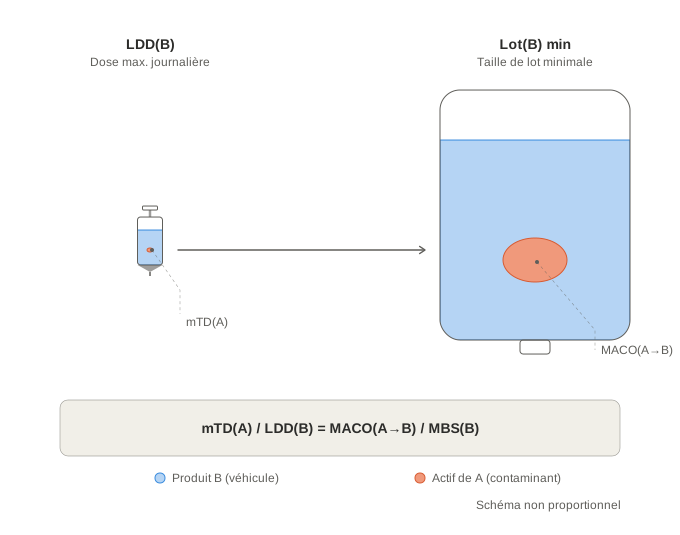
The diagram above gives the intuition behind the calculation: a syringe represents the daily dose of product B (LDD), where the threshold of A (mTD) sets the maximum concentration not to be exceeded. This same concentration is then scaled up to the tank, which represents the manufactured batch.
What the minimum therapeutic dose (mTD(A)) represents: the trigger threshold
The minimum therapeutic dose (mTD(A)) answers a question that only concerns product A: from what quantity of active ingredient A, absorbed by a patient in one day, does a pharmacological effect start to appear?
It is an intrinsic property of product A, based on its dosing regimen. It does not depend on product B, on shared equipment, or on the manufacturing process — it is documented independently of any industrial context.
What the maximum daily dose (LDD(B)) represents: the daily vehicle
The maximum daily dose (LDD(B)) answers a question that, conversely, no longer concerns product A at all: what is the largest quantity of product B a patient receives in a single day, according to its maximum prescribed dosing regimen?
It is a property of product B and its dosing regimen — independent of product A and its therapeutic threshold. In the diagram, it's the very content of the syringe: the total mass of product B that serves as the daily vehicle for the patient, day after day.
Why bring them together: the MACO
The relationship between the minimum therapeutic dose (mTD(A)) and the maximum daily dose (LDD(B)) answers a third question, combining the first two: what is the maximum (mass) quantity of active pharmaceutical ingredient from product A tolerable in product B?
This calculation also includes a safety factor (SF), which represents the margin of caution added to account for uncertainty in pharmacological data — variability between patients, sometimes incomplete data on the minimum dose actually documented. The classic value of this factor is 1000 (though other factors depending on the route of administration can be used), corresponding to the historical criterion known as "1/1000 of the minimum therapeutic dose": the calculation doesn't use the exact tipping threshold, but a deliberately more cautious fraction of it.
Where the confusion comes from
The terminology doesn't help. The minimum therapeutic dose (mTD(A)) and the maximum daily dose (LDD(B)) are both called a "dose" and are both expressed in mg/day. This surface-level resemblance naturally pushes people to treat them as two values of the same nature — whereas one describes the quantity of active ingredient specific to product A, and the other a quantity of product B received by a patient.
What the technical guides say (PDA TR49 and ISPE)
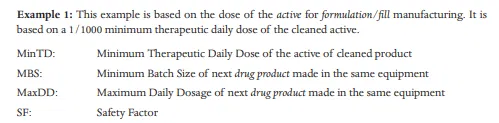
This exact logic is found in PDA TR49. MinTD is defined as the « Minimum Therapeutic Daily Dose of the active of cleaned product » — the minimum therapeutic dose of the active ingredient of the cleaned product. MaxDD, in turn, is indeed indicated as the "Maximum Daily Dose of the next drug product ..." — the maximum daily dose of the next product.
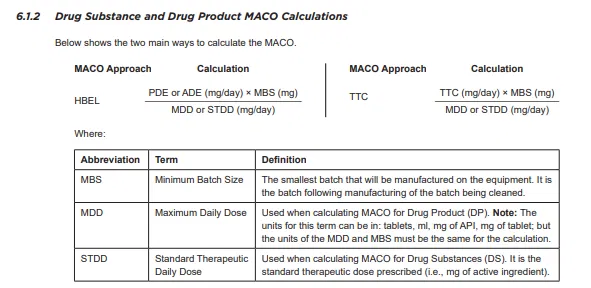
The ISPE guide, in its section dedicated to MACO calculations for active substance / finished product, clarifies the question of units: the MDD (Maximum Daily Dose), used for a MACO on the finished-product side, can be expressed in tablets, mL, mg of API or mg of tablet — provided its units are identical to those of the MBS (batch size).
It is indeed entirely possible to use an LDD in mg/day of active ingredient, provided — and only if — the minimum batch size is also expressed in quantity of active ingredient. The reasoning stays the same, just expressed differently: what is the quantity of active ingredient from product A administered to the patient per unit of active ingredient of product B? The concentration ratio of active ingredient in product B — whether in the minimum batch size or in the maximum daily dose (LDD) — remains unchanged and does not affect the MACO result.
Author's opinion
The approach of an LDD expressed as the total quantity of product B remains preferable, for the following reasons:
- Batch size is natively documented in mass or quantity of finished product in batch records — never in mg of total active ingredient in the batch. Staying on this basis avoids an extra conversion, and therefore one less source of error.
- Active ingredient content per unit of product varies within a tolerance set by specifications (assay, content uniformity), whereas the mass of the finished product is a more tightly controlled parameter in manufacturing. The "finished product" basis relies on more stable data.
This recommendation remains an operational precaution, not a requirement.
This article accompanies the free MACO/ARL calculator available on Hally-Pharma.